
Prisma: Validating Enterprise Adoption Through Open Source Engagement
Prisma is a leading open-source object-relational mapper (ORM) that simplifies database interactions for developers, enabling them to write code in languages like TypeScript or JavaScript without having to also learn SQL. No more context shifting, Prisma acts as a translation layer between the developer’s code and the database, handling SQL queries and data management. Prisma’s community is massive with 375,000 active monthly developers and more than 8 million monthly downloads of the library on NPM.
Overview
Prisma is a leading open-source object-relational mapper (ORM) that simplifies database interactions for developers, enabling them to write code in languages like TypeScript or JavaScript without having to also learn SQL. No more context shifting, Prisma acts as a translation layer between the developer’s code and the database, handling SQL queries and data management. Prisma’s community is massive with 375,000 active monthly developers and more than 8 million monthly downloads of the library on NPM.
The Challenge
Being an OSS product, users can download and use the software without the need for registration, Prisma lacked concrete data on who their users were or how they were using the product. As is the case with most venture-backed businesses, there is keen interest in knowing more details about their user base. “We knew we had different types of users, from people starting to learn about databases to experts in database technologies,” pointed out Nitin Gupta, COO at Prisma, “but we really didn’t know who they were.”
The challenge was to understand and then validate some of their assumptions about their users.
The Solution
Prisma turned to Scarf for a monthly Strategic Insights Report. By integrating Scarf into various parts of their web and software delivery infrastructure, Prisma now knows relevant details about their users in terms of company size, industry, location and much more.
“We get a better translation of generic company data into industry type, location, company size, ARR. All the stuff that Scarf is able to give us.” said Nitin.
The sheer volume of downloads they were seeing was a great sign, but what they really wanted to know was the level of engagement from their users and which of them was actually from a company.
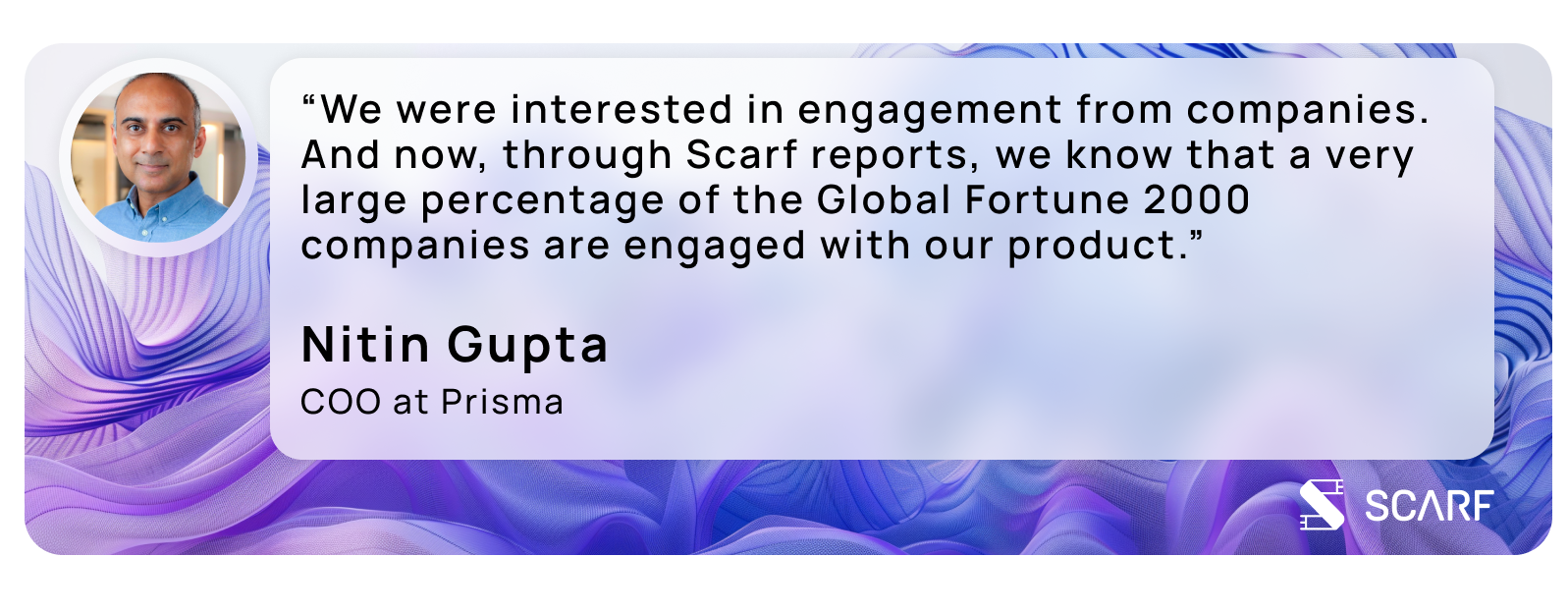
“We were interested in engagement from companies. Engagement is a good and healthy starting point for us to understand our users,” said Nitin. “ And now, through Scarf reports, we know that a very large percentage of the Global Fortune 2000 companies are engaged with our product.”
With newer commercial products getting on the market, Prisma is using Scarf data to make decisions around resourcing their marketing and sales motion.
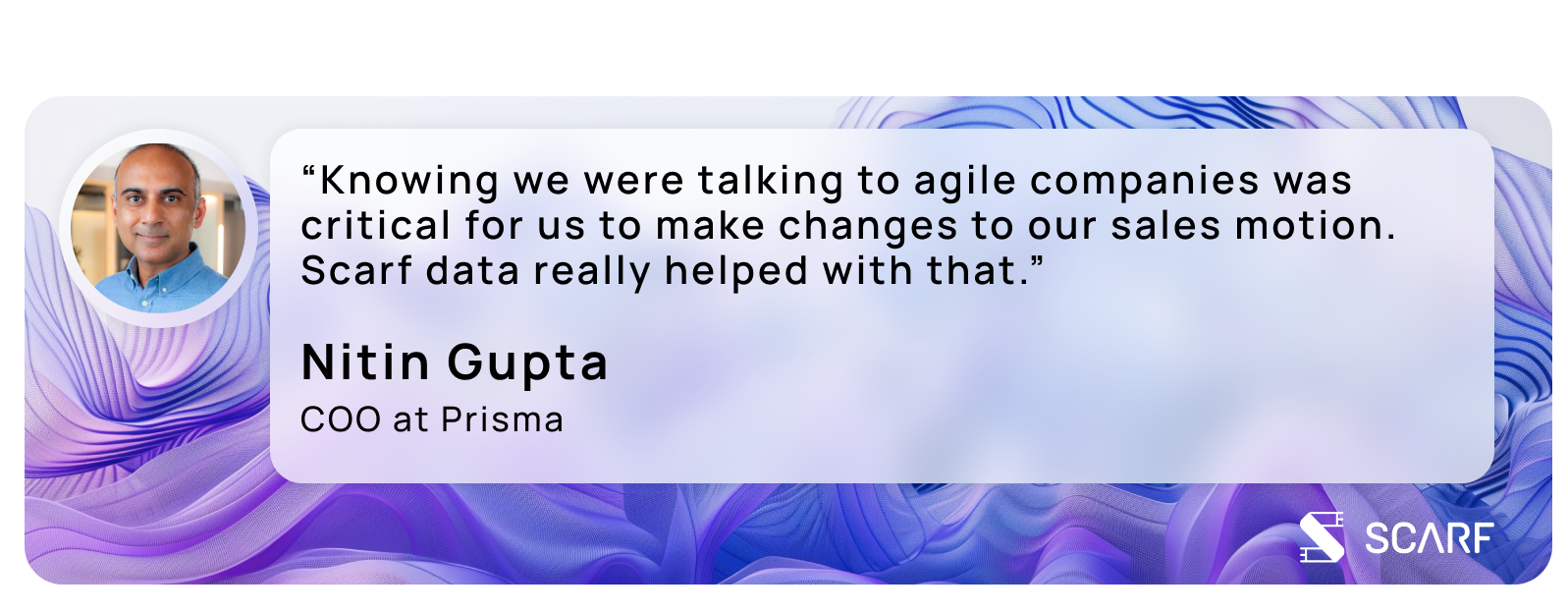
“Using our own data and the Scarf report, we found a lot of our recent sign ups are companies that are able to make database-related infrastructure changes much faster due to their size and ability to move fast” Nitin said. “Knowing we were talking to agile companies was critical for us to make changes to our sales motion. Scarf data really helped with that.”
Key Outcomes
- Open source usage as a key indicator for product-led growth sales motion
- Uncover hidden customer segments
- Improved decision-making and prioritization
- Quantifiable proof that large enterprises are using open source
You Can’t Build an Open Source Business Blind: Stirling PDF Case Study
Learn how Stirling PDF uses Scarf to understand open source adoption, qualify enterprise interest, and build a data-informed business.
Building a Predictable ICP: How Liquibase uses Scarf for GTM Operations
Liquibase is the open source standard for automating database change, with more than 100 million downloads and a community that has been growing for over a decade. Teams adopt Liquibase Community to keep database schema changes in lockstep with fast-moving application releases, then graduate to Liquibase Secure when they need governance, compliance, and control at scale.
From “Flying Blind” to Full Visibility: How Wherobots Uses Scarf to Guide GTM and DevRel
Wherobots is a Series A-stage startup building the Spatial Intelligence Cloud that makes it possible to build production-ready data products with data about the physical world up to 20X faster and at a fraction of the cost of existing approaches. Founded by the creators of Apache Sedona (used by more than 20,000 organizations), Wherobots brings the performance and governance of a modern lakehouse architecture to spatial data workloads through its optimized Sedna-compatible engine and SedonaDB, a spatial-first single-machine runtime. Teams move from complex, do-it-yourself pipelines to 5–20× faster processing without having to manage infrastructure.
