
How Garden Leverages Scarf to Understand and Grow Their User Base
Garden focuses on improving the developer experience and release velocity. They started as an open source project and later developed commercial enterprise offerings based on the OSS. We spoke to Eythor Magnusson, CTO of Garden, about their DevOps platform for managing and testing cloud-native applications.
About Garden
Garden focuses on improving the developer experience and release velocity. They started as an open source project and later developed commercial enterprise offerings based on the OSS. We spoke to Eythor Magnusson, CTO of Garden, about their DevOps platform for managing and testing cloud-native applications.
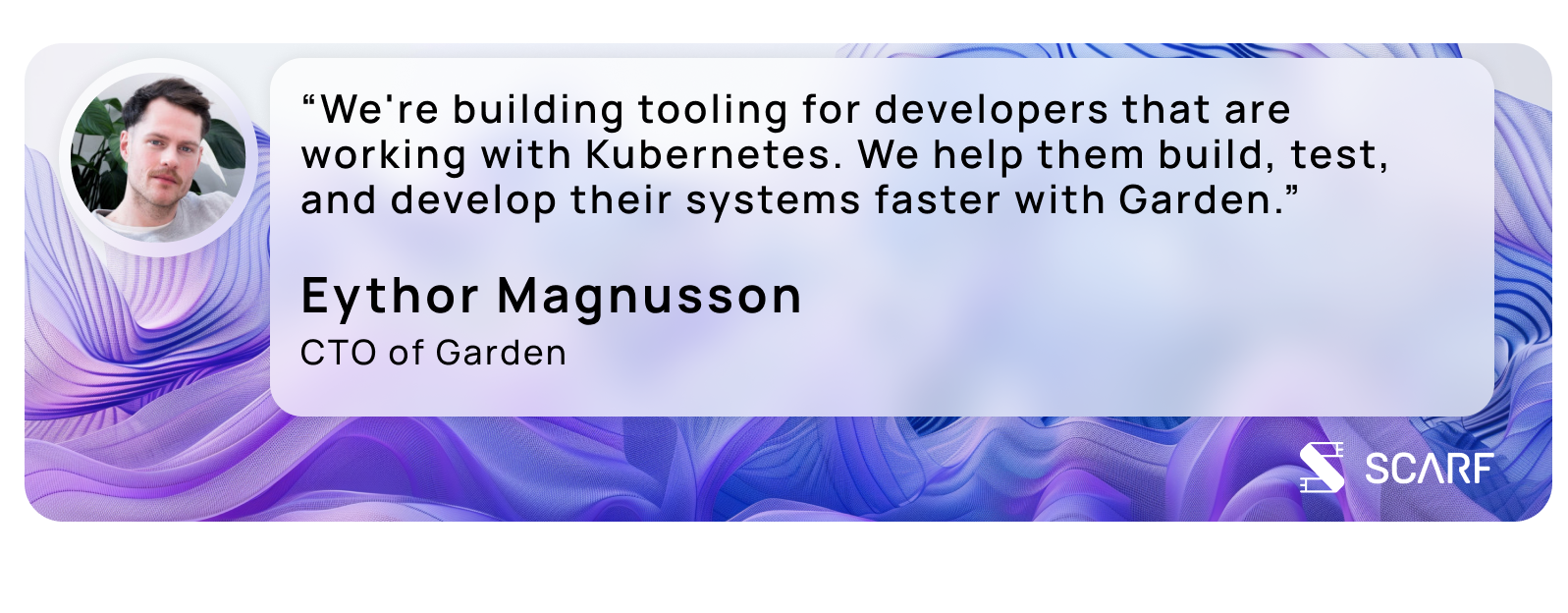
“We’re building tooling for developers that are working with Kubernetes,” says Eythor. “We help them build, test, and develop their systems faster with Garden.”
Challenge
As an open source company, Garden knew how hard it was going to be to get usage data. They developed some anonymous tracking themselves that users could opt out of, but the data gave them limited insights. They knew they had a lot of users, they could see those numbers, but the way the CLI called back, the 1000s of users could have been 1 or 10 or 1000 companies, there was no way of knowing which.
That made it difficult for Garden to figure out the adoption journey from onboarding to active users. They didn’t know if that journey took users a day, a week, or a month if they started from the open source project.
“Garden is often run from within CI pipelines. So it’s not always people that are downloading it onto laptops, but it’s also CI runners, or virtual machines,” explained Eythor. “That makes it twice hard to get meaningful data out of download metrics, that’s where Scarf comes in.”
Solution
Adding Scarf for analytics on open source downloads turned anonymous numbers into company names. Using Scarf’s privacy-first analytics also helped Garden to know what kind of companies were using their OSS and where they were located. Putting all of this together, they gained a much better understanding of their user journey.
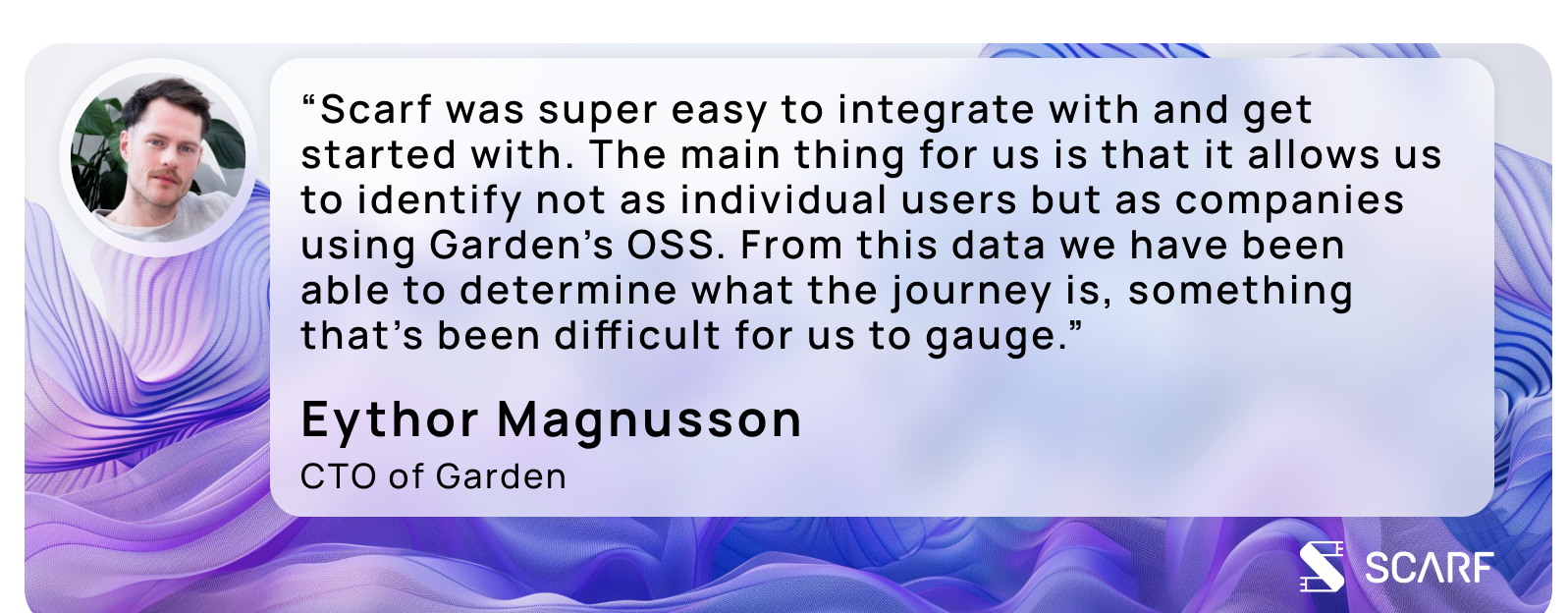
“Scarf was super easy to integrate with and get started with. The main thing for us is that it allows us to identify not as individual users but as companies using Garden’s OSS,” Eythor said. “From this data we have been able to determine what the journey is, something that’s been difficult for us to gauge”
Results
Scarf data has become an important part of sales and marketing intelligence for Garden. With the addition of a SaaS self-serve option, Garden is now also able to identify users who sign up as having used the open source project, a key indicator that they are a good prospect for their commercial product.
“The companies we can identify in Scarf play a key role in helping us understand our user base,” Eythor points out. “We will be doing more with Scarf moving forward.”
The usage of Scarf in Garden’s open source project is documented in their privacy policy.
Key Outcomes
- Privacy-first analytics, ensuring user data is anonymized and used ethically
- User journey mapping from initial OSS adoption to paying customer, revealing valuable insights into conversion times
- Sales and marketing intelligence from their open project
- Understanding user types and locations to inform product development

You Can’t Build an Open Source Business Blind: Stirling PDF Case Study
Learn how Stirling PDF uses Scarf to understand open source adoption, qualify enterprise interest, and build a data-informed business.
Building a Predictable ICP: How Liquibase uses Scarf for GTM Operations
Liquibase is the open source standard for automating database change, with more than 100 million downloads and a community that has been growing for over a decade. Teams adopt Liquibase Community to keep database schema changes in lockstep with fast-moving application releases, then graduate to Liquibase Secure when they need governance, compliance, and control at scale.
From “Flying Blind” to Full Visibility: How Wherobots Uses Scarf to Guide GTM and DevRel
Wherobots is a Series A-stage startup building the Spatial Intelligence Cloud that makes it possible to build production-ready data products with data about the physical world up to 20X faster and at a fraction of the cost of existing approaches. Founded by the creators of Apache Sedona (used by more than 20,000 organizations), Wherobots brings the performance and governance of a modern lakehouse architecture to spatial data workloads through its optimized Sedna-compatible engine and SedonaDB, a spatial-first single-machine runtime. Teams move from complex, do-it-yourself pipelines to 5–20× faster processing without having to manage infrastructure.
