
CopilotKit Case Study: Leveraging Scarf to Uncover Hidden Open-Source Opportunities
CopilotKit is building the infrastructure for deeply integrated AI assistance, or co-pilots, into products for companies without the resources of Microsoft or Google. They began as an open-source project and have since added an enterprise cloud offering to complement their open-source solution.
About CopilotKit
CopilotKit is building the infrastructure for deeply integrated AI assistance, or co-pilots, into products for companies without the resources of Microsoft or Google. They began as an open-source project and have since added an enterprise cloud offering to complement their open-source solution.
The Challenge
As an open-source project, CopilotKit faced the classic challenge of understanding their user base and identifying high-potential customers. With limited data points like GitHub stars, npm installs, and Discord community interactions, it was difficult to gain actionable insights into who was using their technology and how it was being used.
“Before Scarf we really only had two data points. We had our GitHub Stars. So we kind of have a number, and you see who these people are, but making that actionable is not that easy”, said Atai Barkai, CEO of CopilotKit. “We also had npm installs, which is just a raw number of how many installs you get.”
Solution
CopilotKit implemented Scarf to gain visibility into their open-source community. By adding Scarf to their documentation, they could see which companies were actively engaging with their resources, providing valuable insights into potential leads and customer segments.
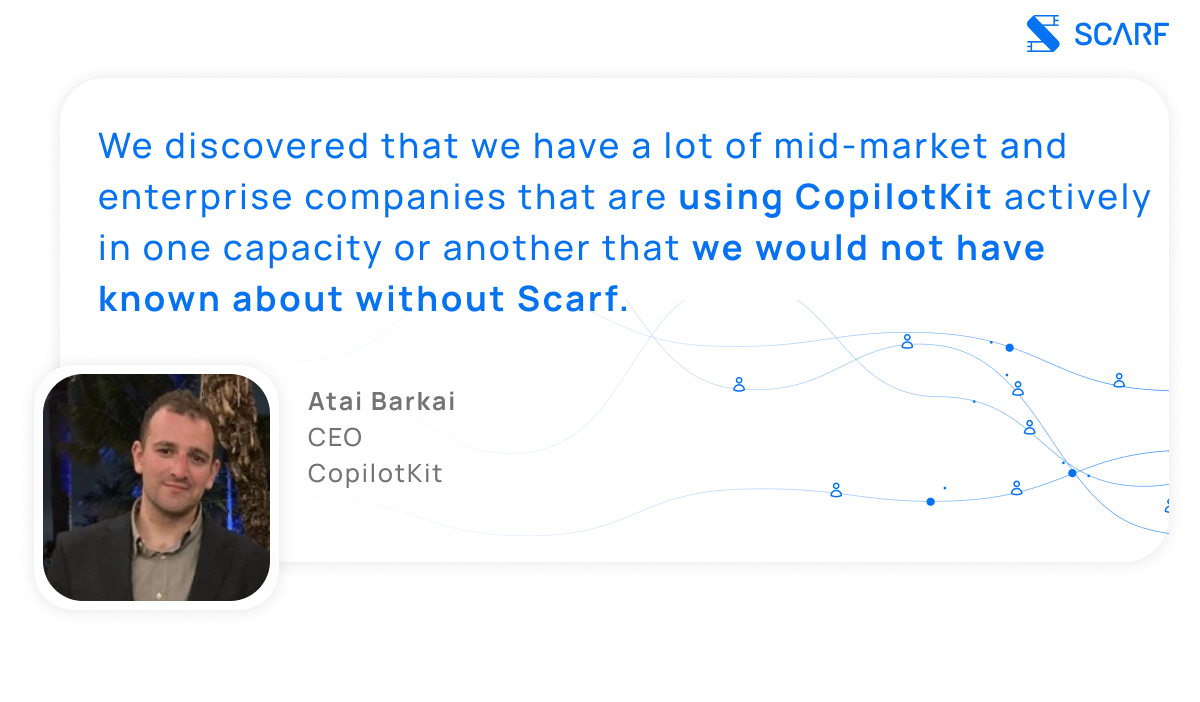
“When we signed up for Scarf, we discovered lots of enterprise and mid-market users of CopilotKit we would not have known about otherwise,” reported Atai. “We’re seeing very impressive companies that have hundreds of hits to our documentation, which we can infer are either using production or will be.”
Results
Scarf has been instrumental in uncovering hidden opportunities for CopilotKit:
- Identifying High-Value Users: Scarf revealed that major companies like Visa, Comcast, Booking.com, Walmart, and Zocdoc were actively using CopilotKit. This information was previously unknown and helped CopilotKit prioritize their sales and marketing efforts.
- Discovering New Customer Segments: Scarf data revealed a trend of top software consultancies using CopilotKit. This led CopilotKit to develop a new outbound motion specifically targeting this persona, creating a new channel for enterprise adoption.
- Informing Product Development: By understanding how users interact with their documentation, CopilotKit can identify pain points and prioritize features that meet the needs of their most active users, including large enterprises.
- Building a Strong Foundation for Enterprise Sales: Scarf’s insights are helping CopilotKit build a targeted sales pipeline, focusing on companies with a demonstrated interest in their open-source technology.
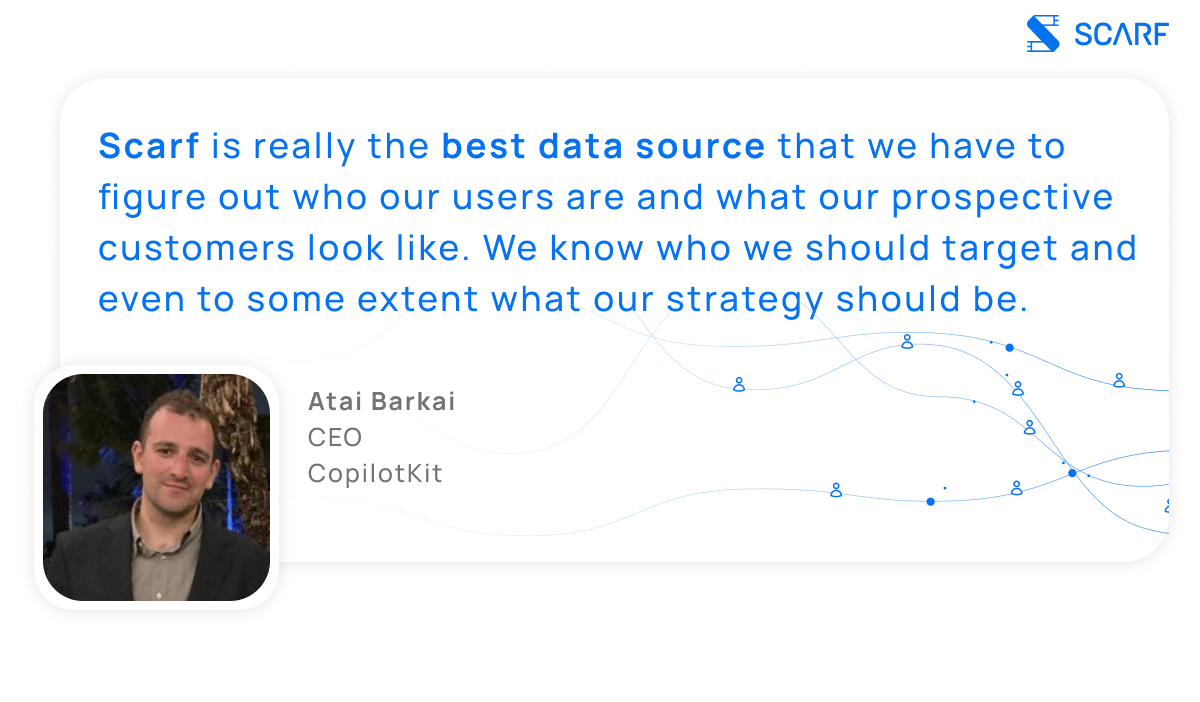
“Scarf is really the best data source that we have to figure out who our users are and what our prospective customers look like. We know who we should target and even to some extent what our strategy should be.”
Key Outcomes
- Actionable insights: Scarf provided CopilotKit with actionable data on their open-source users, going beyond simple metrics like stars and downloads.
- New customer segment identification: CopilotKit discovered a new customer segment (software consultancies) through Scarf data.
- Targeted sales and marketing: Scarf enabled CopilotKit to tailor their outreach and focus on high-potential leads.
- Improved product development: Scarf insights are helping CopilotKit prioritize features that meet the needs of their target users.
- Strong foundation for enterprise sales: Scarf’s data is playing a crucial role in CopilotKit’s strategy to become the default choice for building AI co-pilots in the enterprise.
As CopilotKit continues to grow and evolve, Scarf will remain a crucial tool in their arsenal, providing valuable insights to drive their open-source and commercial success.
You Can’t Build an Open Source Business Blind: Stirling PDF Case Study
Learn how Stirling PDF uses Scarf to understand open source adoption, qualify enterprise interest, and build a data-informed business.
Building a Predictable ICP: How Liquibase uses Scarf for GTM Operations
Liquibase is the open source standard for automating database change, with more than 100 million downloads and a community that has been growing for over a decade. Teams adopt Liquibase Community to keep database schema changes in lockstep with fast-moving application releases, then graduate to Liquibase Secure when they need governance, compliance, and control at scale.
From “Flying Blind” to Full Visibility: How Wherobots Uses Scarf to Guide GTM and DevRel
Wherobots is a Series A-stage startup building the Spatial Intelligence Cloud that makes it possible to build production-ready data products with data about the physical world up to 20X faster and at a fraction of the cost of existing approaches. Founded by the creators of Apache Sedona (used by more than 20,000 organizations), Wherobots brings the performance and governance of a modern lakehouse architecture to spatial data workloads through its optimized Sedna-compatible engine and SedonaDB, a spatial-first single-machine runtime. Teams move from complex, do-it-yourself pipelines to 5–20× faster processing without having to manage infrastructure.
